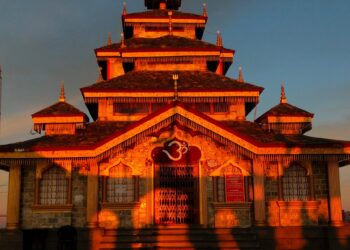

In the hills of Kumaon, faith doesn’t just live in rituals; it speaks, it writes, and it waits for justice. Among the many revered deities of Uttarakhand, Golu Devta stands apart as the God of justice. A divine figure whom people approach not just with prayers, but with written petitions, much like a court of law.
Who is Golu Devta?
Golu Devta, also known as Goril Devta, is believed to be a historical king from the Katyuri dynasty, often associated with the Champawat region. Oral traditions describe him as a ruler who was known for his fairness, courage, and unwavering commitment to justice. After his death, he was deified by the local people, who began worshipping him as a guardian of truth.
One popular legend says that Golu Devta was wronged in his lifetime and later became a symbol of न्याय (justice), ensuring that truth always prevails. His story has been preserved through generations via folk songs, jagar rituals, and local storytelling traditions.
The Unique Tradition of Written Appeals
What truly makes Golu Devta’s worship distinctive is the practice of submitting written pleas. Devotees write letters, sometimes even on stamp paper detailing their grievances, disputes, or wishes. These letters are then tied or hung in the temple premises.
At the famous Chitai Temple near Almora, thousands of such letters flutter alongside countless bells offered by devotees whose wishes were fulfilled. The belief is simple yet powerful: if your cause is just, Golu Devta will deliver justice.
This tradition has grown so much that even legal cases, job issues, personal disputes, and missing belongings are written and submitted here. Some devotees even send registered post to the temple.
Major Temples of Golu Devta
1. Chitai Temple (Almora)
The most iconic shrine dedicated to Golu Devta. Known for its sea of bells and letters, it has become a symbol of faith in justice.
2. Ghorakhal Temple (near Nainital)
Located in a serene cantonment area, this temple is also famous for its peaceful environment and bell offerings.
3. Champawat Region
Believed to be closely associated with Golu Devta’s origins and early worship.
Why Bells?
Offering a bell is a gesture of gratitude. When a devotee’s wish is fulfilled, they return to the temple and hang a bell as a mark of thanks. Over time, this has transformed temple spaces into resonant landscapes of metal chimes, each one carrying a story of hope answered.
Cultural Significance
Golu Devta is not just a religious figure but a cultural anchor of Kumaoni identity. His presence is deeply woven into local traditions:
- Jagar rituals: Spiritual ceremonies where deities are invoked through music and trance.
- Folk songs and ballads narrating his life and justice.
- Community faith in moral justice beyond human systems.
Faith Beyond Formality
In an age where legal systems can be slow and complicated, the faith in Golu Devta reflects a deeper human need for fairness, for being heard, and for truth to win. Whether one sees it as belief or symbolism, the devotion here is undeniably sincere. People don’t just pray at his temples, they present their case.
And in the quiet hills of Kumaon, where bells echo through pine forests, many believe justice still answers.
Conclusion
Golu Devta represents more than mythology, he embodies a living tradition where faith and justice meet. The temples dedicated to him are not just places of worship, but spaces where people come with hope, leave with विश्वास, and often return with gratitude.
If you ever visit Kumaon, step into one of his temples; not just as a tourist, but as a listener. Because every bell there has a story to tell.